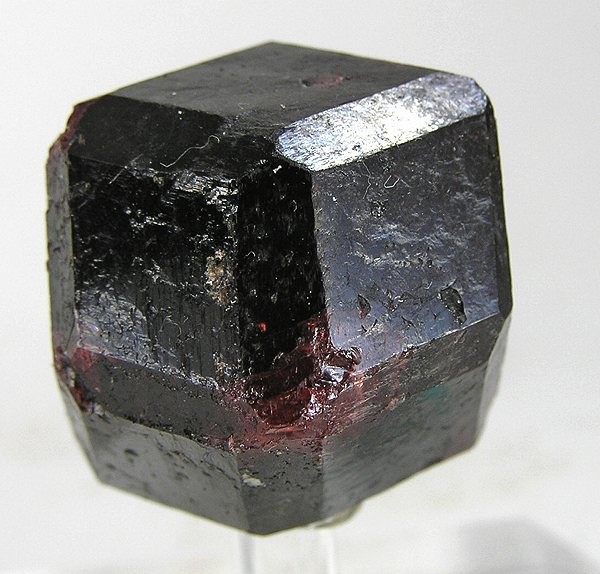
This dark crystal shows a little red near its lower front edge. Light, thickness and viewing angle affect the colour you can see in a photograph.
Rob Lavinsky, iRocks.com / CC BY-SA 3.0 (via Wikimedia Commons). Original image; displayed at a smaller size.Identification clues
Almandine may appear deep red, brownish red, violet-red or almost black. Well-formed crystals have many faces, while other specimens occur as rounded grains or masses. A thick dark crystal may reveal red more clearly near a thinner edge.
Mineral facts and formation
This iron-and-aluminium garnet is common in metamorphic rocks such as schist and gneiss. It also occurs in other settings. Garnets can have intermediate compositions: almandine forms solid-solution series with pyrope and spessartine.
Lookalikes and useful comparisons
A dark surface can resemble other minerals until the shape and light transmission are considered. Compare it with hematite’s metallic-looking plates. Red colour alone does not establish that a garnet is almandine rather than another garnet composition.
Care for a display specimen
Hardness is resistance to scratching, not protection from breakage. Keep crystal edges from striking other specimens and handle any attached rock gently. Use conservative display care when the matrix or treatment history is unknown.
Read the full crystal care guide →Look a little closer
Try this observation.
Look for the small reddish area in the otherwise dark reference crystal. Note its position, then describe two visible faces. Do not infer the colour of its unseen interior.
Does garnet name just one mineral?
No. Garnet is a group of related minerals. Almandine is one member, and natural garnets often contain a mixture of end-member components. A precise species label may require more than visual inspection.
Sources and further reading
Reference information checked 4 October 2026. These sources describe minerals generally; they do not identify a particular stone.