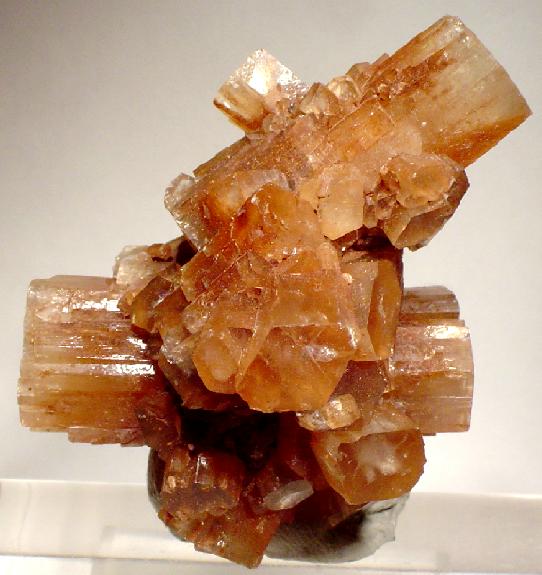
Compare the long faces and different growth directions in this aragonite cluster. Its brown colour is one of several appearances aragonite can have.
Rob Lavinsky, iRocks.com / CC BY-SA 3.0 (via Wikimedia Commons). Original image; displayed at a smaller size.Identification clues
Aragonite can form slender needles, branching masses and prismatic crystals. Repeated twinning can make groups appear six-sided even though its crystal system is orthorhombic. It can be colourless or show several colours; brown clusters are only one appearance.
Mineral facts and formation
Aragonite and calcite have the same chemical formula but different crystal structures. This relationship is called polymorphism. Aragonite occurs in settings including caves and hot springs, and it is also produced by marine organisms.
Lookalikes and useful comparisons
Compare aragonite’s clustered prisms with the flat break surfaces in the calcite guide. That contrast is useful for learning, but neither mineral always looks like the chosen photograph. Shape and colour alone do not prove a species or locality.
Care for a display specimen
Support a cluster from its solid base, not its projecting crystals. Keep it away from acidic cleaners and harder specimens. Do not use vinegar or break off a needle as a home identification test.
Read the full crystal care guide →Look a little closer
Try this observation.
Count the different directions in which the larger crystals project in the photograph. Then choose one crystal and trace its visible edges without guessing the hidden faces.
If the formula matches calcite, why use another name?
Mineral identity includes how atoms are arranged, not just which elements are present. Aragonite and calcite package calcium carbonate differently, giving them distinct structures and physical properties.
Sources and further reading
Reference information checked 4 October 2026. These sources describe minerals generally; they do not identify a particular stone.