01 · Read the clues
Start with surfaces that already exist.
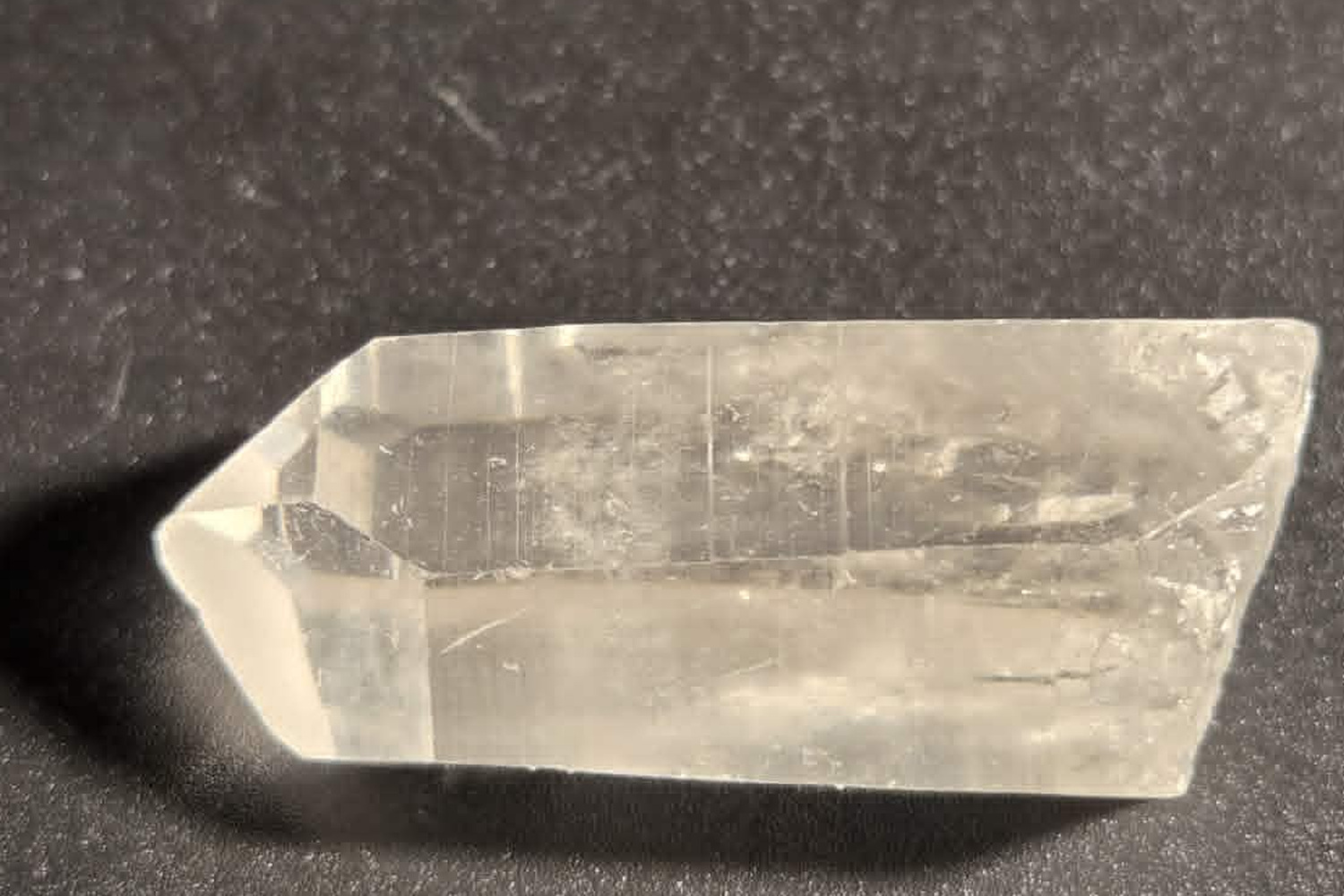
An uncut quartz crystal may have six-sided prism faces and a pointed end. Calcite has a variety of growth shapes; its cleavage fragments can look like slanted boxes called rhombohedra. Growth faces and cleavage faces are not the same thing.
Turn the specimen gently and follow the edges between faces. Are there repeated sloping relationships, or curved broken patches? A rounded tumble or a polished carving may hide these clues. Do not force a name when the useful surfaces are missing.
02 · Read the clues
What the reference photo can show.
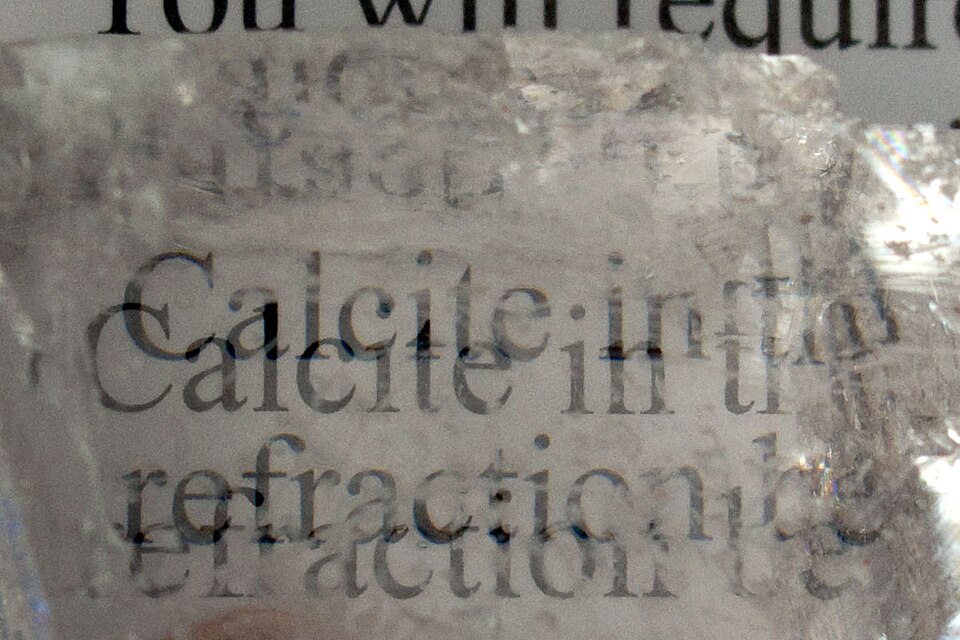
The calcite reference image places a transparent specimen over print, showing doubled letters. This is an illustration of double refraction in that piece and orientation. The photograph comes from Wikimedia Commons; its credit is retained below.
Use the image as an observation exercise rather than a pass-or-fail test for your stone. Cloudiness, roughness, thickness and viewing direction can make a comparison difficult. Not seeing doubled text does not rule out calcite.
03 · Read the clues
Different hardness means different handling.
Quartz has a reference Mohs hardness of 7 and calcite 3. Keep them in separate padded spaces rather than loose together, so the harder material does not rub across the softer surface. Hardness is not a measure of resistance to every kind of damage.
Skip scratch, acid and deliberate break tests on display pieces. Start by recording visible clues and checking the label. If you need a firm identification, let a mineral specialist decide what further examination is suitable.
Try it without damaging a stone
A one-minute observation
Sketch the outline of one visible face in each photograph. Mark where an edge is clear and where you cannot follow it. Then write one question the photograph cannot answer. That uncertainty belongs in an identification notebook too.
Is a clear, glassy stone automatically clear quartz?
No. Calcite and other materials can share that appearance. This comparison narrows two possibilities; it is not a complete identification key for every clear stone.
Sources and further reading
Checked 4 October 2026. General mineral information supports these comparisons; collection labels are not laboratory identifications.