Observe
Make a specimen record
Keep the label, visible features, a sketch and unanswered questions together.
Download observation sheet (PDF, A4) ↓
Quartz family · Collection guide
Look for a glassy, clear-to-milky body and the suggestion of six-sided crystal faces.
Quartz is silicon dioxide, has a Mohs hardness of 7, and normally fractures rather than cleaves.
Use a soft cloth or brief warm soapy water. Avoid sudden temperature changes and hard knocks.
Read the full crystal care guide →From Rock & Crystal Secrets · YouTube Short · 0:49
Explore a quartz story, then read the Clear Quartz guide for identification clues and care.
The video may show a different specimen. Compare what you see with this page’s identification and care notes.
Our collection · A closer look
Look at the outline, see-through areas and pale lines in our specimen labelled Clear Quartz. A pointed shape is a useful observation, but it does not tell us whether a piece grew that way or was shaped.
The left end narrows to a point, with adjoining surfaces visible around it. Record the shape without assuming the point or those surfaces are naturally grown.
Some central areas look more see-through than the pale upper and lower edges. The background, reflections and thickness all affect this view; “clear” does not mean every part looks equally transparent.
Pale lines and darker streak-like details cross the right half. This photograph does not reliably show which are inside the specimen and which lie on its surface.
Sketch the outer shape, then mark one clearer area and one cloudy area. Keep those observations separate from the supplied name. Do not scratch or chip the piece to try to explain a line.
Get the free observation sheet →A photograph cannot confirm quartz rather than glass or another clear material. It cannot establish hardness, distinguish every surface mark from an internal feature, or prove whether this piece was cut or polished.
Compare quartz and calcite →Look a little closer
Compare the clear and cloudy areas in the photograph. Follow the flat crystal faces and look for changes in transparency along the edges.
Modern crystal traditions associate Clear Quartz with clarity, intention, and amplification.
These are cultural or spiritual associations, separate from mineral science. They are not demonstrated health or financial effects.
Clear Calcite and glass can resemble Clear Quartz. Compare naturally grown faces and internal features, but do not treat transparency or a carved point as proof of identity. Use the reference guides to learn why hardness and cleavage are separate properties.
Further reading: Handbook of Mineralogy: Quartz (PDF) (opens in a new tab)
Practical answers
Yes. Rock crystal is the traditional name for colourless, transparent quartz. The word “crystal” on its own is broader and is also used commercially for some glass products, so ask for the material name rather than relying on that word alone.
They are varieties of the same mineral, quartz. Amethyst is purple; clear quartz is colourless. Colour helps describe a specimen, but it does not establish whether a particular object is natural quartz, laboratory-grown quartz or an imitation.
Avoid damaging a valued specimen for a single clue. Quartz has Mohs hardness 7, but hardness alone is not a complete identification. Start with photographs, the supplied label and visible features; ask a qualified specialist if a reliable identification matters.
References checked 18 October 2026. These answers describe the material generally; they do not certify this specimen.
Your next discovery
Build on what you noticed about Clear Quartz. Choose a next step.
Observe
Keep the label, visible features, a sketch and unanswered questions together.
Download observation sheet (PDF, A4) ↓Understand
Plain-English explanations for the clues you are learning to describe.
Compare
Explore the differences and the limits of identifying stones by appearance.
Watch
Jump to the related videos below. Notice what changes with movement and light.
Choose a related video ↓From Rock & Crystal Secrets
Choose a video about Clear Quartz, then return to the identification clues above. What can you observe, and what still needs checking?
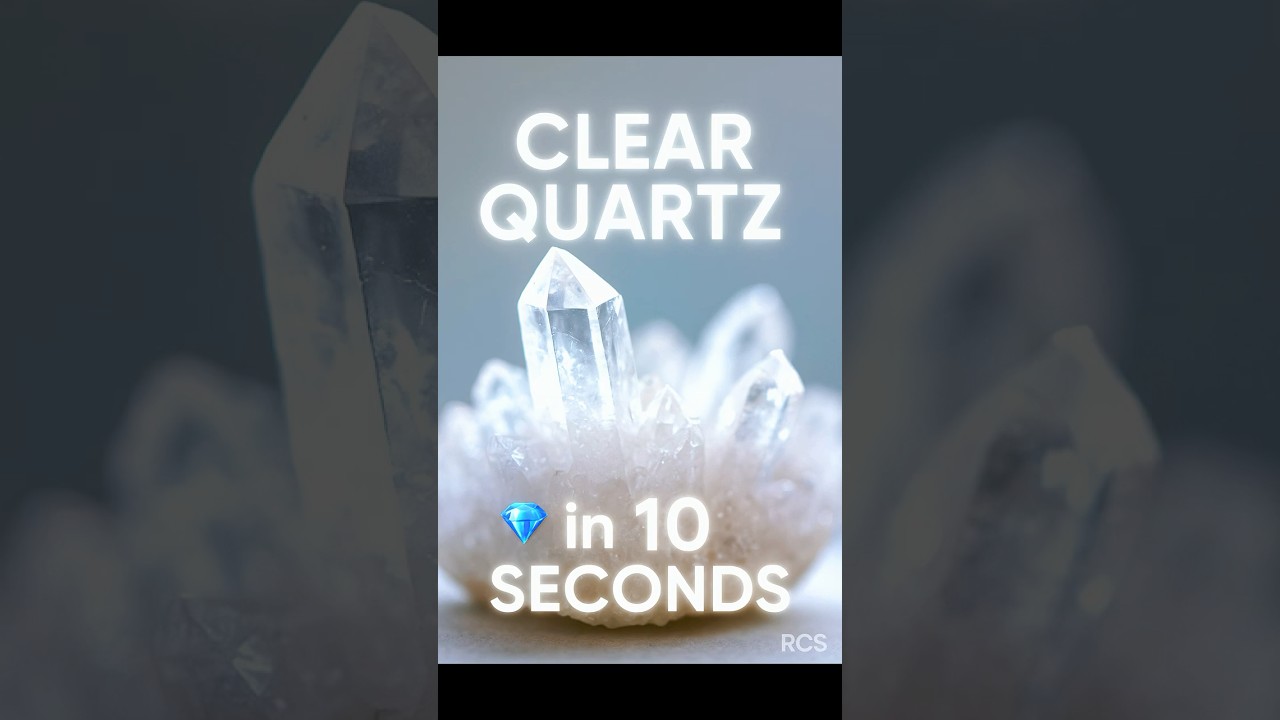 0:14
YouTube ShortNov 2025
A quick introduction to recognising clear quartz. Continue with the guide for more than a first impression.
Watch on YouTube (opens in a new tab)Read alongside this video
Videos explore this crystal topic; they may show different specimens. Traditional meanings are presented separately from scientific identification.