Video companion · About 3 minutes to read

Five crystal-buying clues to check before you buy

Pause at each example in our crystal-buying video. Turn the clue into a question you can ask a seller about the material, its treatment or how the piece was made.

Watch on YouTube (opens in a new tab)

Original video · 5:34
5 Fake Crystal Tricks Sellers Don’t Want You to Know

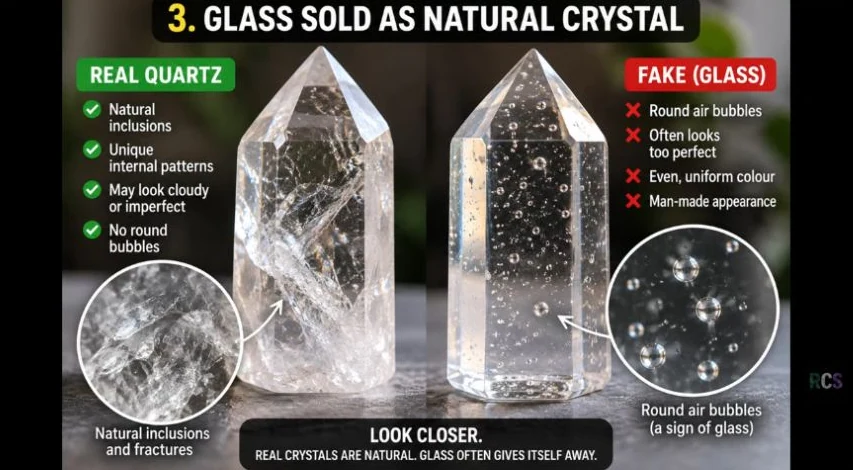
Two clear points on a comparison slide with enlarged internal details shown in circles
Still from our YouTube video at 2:25.

What to notice as you watch

The video uses illustrated comparisons. Use each image to practise asking for evidence about the exact piece you are considering.

Select a time to open that moment on YouTube.

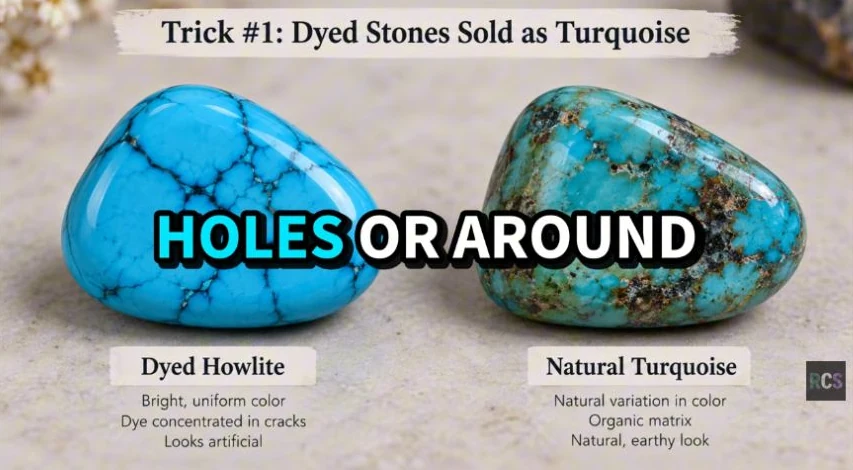
  1. Video comparison of blue stones labelled dyed howlite and natural turquoise0:40 · Dye along cracks (opens in a new tab)

    Follow the dark webbing on the blue examples. Ask whether the material has been dyed and whether the photo shows the piece you would receive.

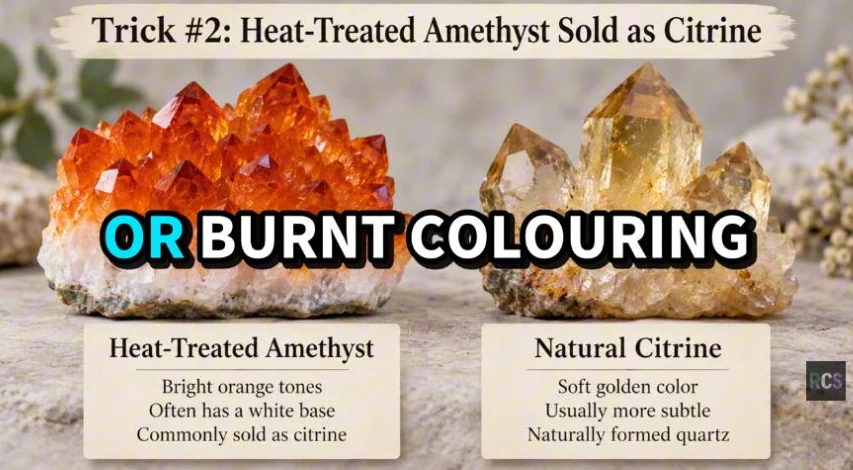
  2. Video comparison of an orange quartz cluster and paler golden points1:40 · Orange points and a pale base (opens in a new tab)

    Locate the strongest orange in the cluster and trace it toward the base. Ask whether the seller knows if the quartz was heated to change its colour.

  3. Two clear points on a comparison slide with enlarged internal details shown in circles2:25 · A clue inside the piece (opens in a new tab)

    The comparison slide points to round internal features. Ask for a magnified image or a material identification if the distinction between glass and quartz matters to you.

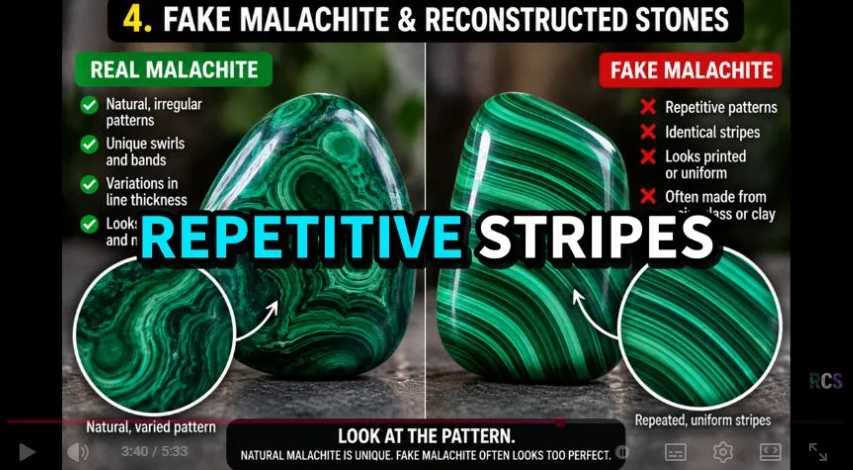
  4. Green banded examples in the video’s malachite comparison3:40 · Repeating bands (opens in a new tab)

    Follow a green band to the edge and compare its width with the one beside it. Ask whether the piece is solid, assembled or made with a binder.

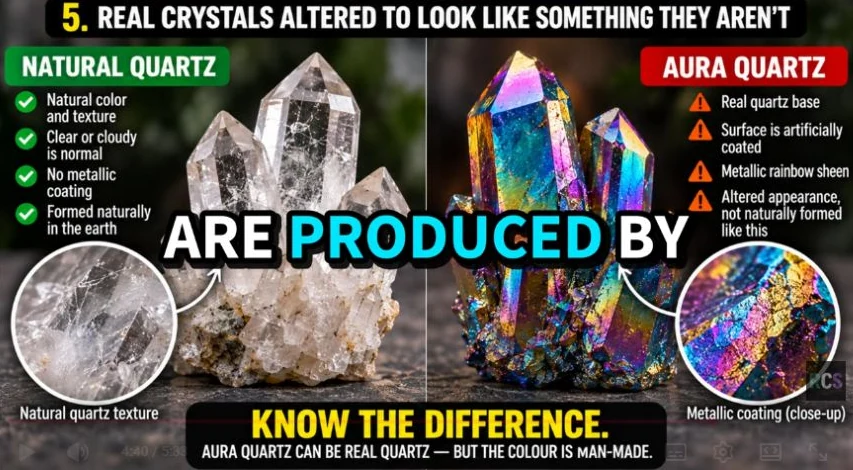
  5. Colourless quartz and bright iridescent points in the video’s coating comparison4:40 · A surface coating (opens in a new tab)

    Look at where the rainbow colour sits on the point. Ask whether the surface has been coated and request a photograph from another angle.

01 · Look a little closer

Ask about material, treatment and construction.

Write three separate answers on a listing. What material is it? What changes were made to it? How was this particular piece made or assembled? Those questions cover different issues. A quartz specimen may be genuine quartz with colour added by heat or a surface coating. An imitation resembles another material.

A label that simply says “natural” leaves important details open. Ask if it refers to the material growing in nature or to the colour and finish you see now. Save the seller’s wording with the photos so you can check that you received the described piece.

02 · Look a little closer

Use a clue to decide what to check next.

Colour concentrated in cracks is one reason to ask about dye. Orange colour on a quartz cluster is one reason to ask about heat. Examine the light, angles and finish in the seller photos and record the clue you can point to.

When material or treatment matters to the purchase, ask what supports the claim. GIA’s coloured-stone identification service specifies material and detectable treatments. Compare any report offered with the listed item and its images before relying on it.

Pause. Replay. Describe.

Try this while watching

  1. Open one of the five viewing points and describe a single visible feature in your own words.
  2. Turn that description into a question about the material, treatment or construction.
  3. Record the seller’s answer and keep any uncertainty alongside it.

Sources and further reading

Written for Rock & Crystal Secrets. Video narration and mineral references checked 20 November 2026. This is an original reading companion, not a transcript or a laboratory identification.
More video guides

Find a moment to pause, see what to look for and follow the matching mineral or collecting guide.

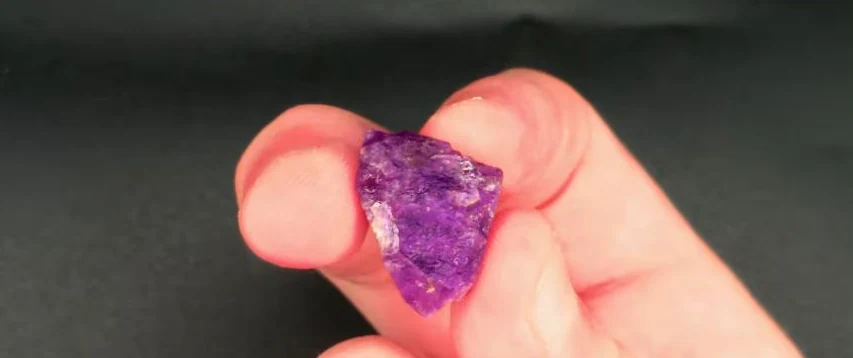
A small rough purple stone pinched between two fingers

Your first crystals: four details to look for

Pause on Amethyst, Rose Quartz, Clear Quartz and Obsidian, then use the details you see to start a specimen record.

Read the video guide →
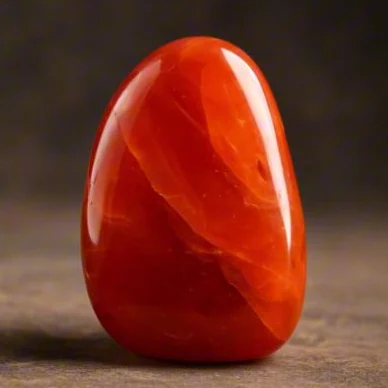
A polished red-orange stone upright with curved orange lines and bright edge reflections

Carnelian: look at the colour, then follow the carving story

Compare two orange-red examples from the video and see how a museum records a Roman ring with carved carnelian.

Read the video guide →
Amethyst collection photograph

Amethyst explained: purple quartz, heat and care

Explore the science behind our Amethyst video, clarify the heat-treatment story and learn how to care for your specimen.

Read the video guide →
Citrine collection photograph

Is your citrine natural or heat-treated?

Watch our Citrine Short, examine the colour clues and learn what to ask before buying a specimen.

Read the video guide →
Labradorite collection photograph

Why labradorite flashes as it moves

Follow the changing colour, learn about labradorescence and keep observations separate from symbolic meanings.

Read the video guide →
Volcano Agate collection specimen under UV illumination

Volcano Agate under UV: what the glow tells us

Read the UV reveal carefully, understand fluorescence and learn what a trade name or glowing patch cannot prove.

Read the video guide →
Moonstone collection photograph

Moonstone’s blue flash, explained

Explore the Short’s light effect, practise describing a moving sheen and understand the limits of a moonstone label.

Read the video guide →
← Browse all featured videos