Three dark stones. Glass, quartz and an iron oxide.
Obsidian is natural volcanic glass. Black onyx in the gem trade usually refers to black chalcedony, a quartz-family material that is commonly colour-treated. Hematite is iron oxide, Fe₂O₃. All three can look dark and shiny after polishing, so black colour alone cannot separate them.
Obsidian
Our specimen labelled Obsidian. Notice the dark body, bright edge reflection and curved line across the surface. The photo does not establish its origin.
Black Onyx
Our specimen labelled Black Onyx. Brownish areas and bands are visible in this photograph. We retain the supplied label; mineral identity and treatment have not been confirmed by testing.
Hematite reference specimen
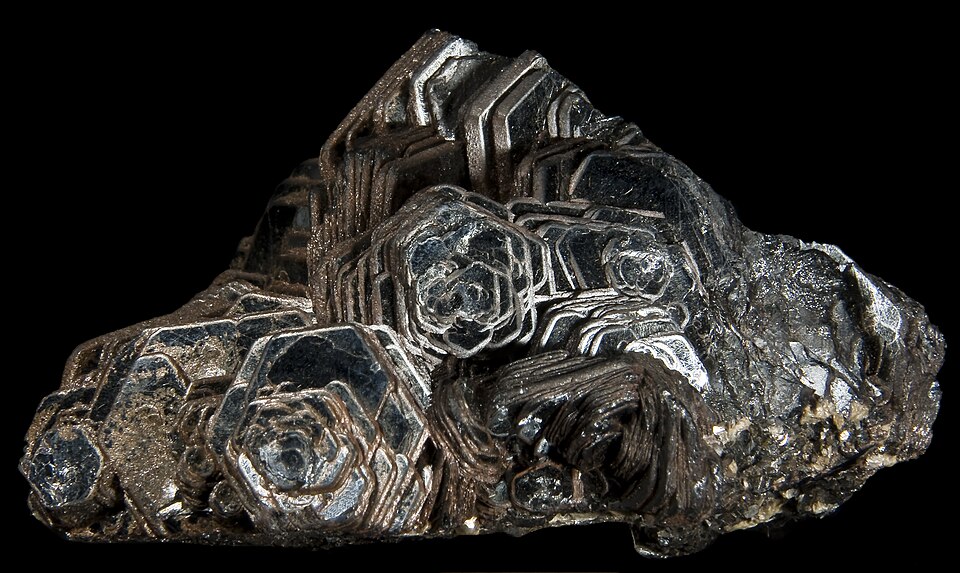
Credited hematite reference specimen, not from our collection. Its overlapping metallic-looking plates illustrate an iron-rose form, rather than a polished bead.
Reference properties describe the materials generally. They do not authenticate the photographed specimens.
Obsidian vs black onyx vs hematite: reference properties
Clue
Obsidian
Black onyx
Hematite
Material
Natural volcanic glass
Chalcedony in the quartz family; a trade name can leave treatment questions open
Iron oxide mineral · Fe₂O₃
Surface appearance
Often glassy; polish can make reflections stronger
Waxy to glassy; polished pieces can look very shiny
Metallic to dull; earthy forms can look red-brown
Patterns and forms
Can be uniform, streaked or banded
Bands may be visible, faint or obscured by dark colour
Plates, rounded masses and earthy forms all occur
Mohs hardness
Typically 5–5.5
Typically 6.5–7 for chalcedony
Usually 5–6; earthy aggregates can be much softer
Useful reference clue
Curved, shell-like fracture surfaces can have extremely sharp edges
Very fine quartz-family structure; banding alone does not confirm identity
Characteristic red to red-brown streak, unlike its possible grey surface
What this does not prove
A glossy black object is not automatically natural obsidian
Even black colour does not prove untreated onyx
Shine or magnetic attraction alone does not prove hematite
Material
Obsidian
Natural volcanic glass
Black onyx
Chalcedony in the quartz family; a trade name can leave treatment questions open
Hematite
Iron oxide mineral · Fe₂O₃
Surface appearance
Obsidian
Often glassy; polish can make reflections stronger
Black onyx
Waxy to glassy; polished pieces can look very shiny
Hematite
Metallic to dull; earthy forms can look red-brown
Patterns and forms
Obsidian
Can be uniform, streaked or banded
Black onyx
Bands may be visible, faint or obscured by dark colour
Hematite
Plates, rounded masses and earthy forms all occur
Mohs hardness
Obsidian
Typically 5–5.5
Black onyx
Typically 6.5–7 for chalcedony
Hematite
Usually 5–6; earthy aggregates can be much softer
Useful reference clue
Obsidian
Curved, shell-like fracture surfaces can have extremely sharp edges
Black onyx
Very fine quartz-family structure; banding alone does not confirm identity
Hematite
Characteristic red to red-brown streak, unlike its possible grey surface
What this does not prove
Obsidian
A glossy black object is not automatically natural obsidian
Black onyx
Even black colour does not prove untreated onyx
Hematite
Shine or magnetic attraction alone does not prove hematite
01 · Read the clues
Compare the reflections, not just the colour.
In the photographs above, the obsidian has a bright reflection along one edge, the Black Onyx-labelled piece shows warmer bands, and the hematite has many bright edges around overlapping plates. These are observations of three particular images, not a checklist every specimen must match.
With a specimen in hand, gently turn it under one ordinary light and describe how the reflection changes. Keep the lighting consistent. Polishing, camera exposure and reflections can make different materials look alike. A rounded, polished stone also hides many of the natural shapes that might otherwise help.
02 · Read the clues
What does “black onyx” actually mean?
Onyx is a chalcedony name associated with parallel banding. In commerce, “black onyx” also describes uniformly black chalcedony, commonly treated to deepen its colour. A treated quartz-family stone is not the same material as a glass imitation, and a sales label does not settle either question.
Our photograph keeps the original Black Onyx collection label even though the image shows brownish areas and bands. We have not changed its colour to match a textbook example. Keep three separate records when buying: the seller’s name, what you can observe, and any documented identification or treatment disclosure.
03 · Read the clues
Why hematite can look grey but leave a red streak.
Streak means the colour of powdered mineral, rather than the colour of an intact surface. Hematite’s familiar metallic-grey form and its earthy red form share an iron-oxide identity; references describe a red to reddish-brown streak. The photograph here shows a metallic platy example, not the full range.
That property is useful to understand without rubbing a polished stone on a tile. A streak test removes material. The hardness numbers in the table are also reference values, not instructions to scratch your collection. Mohs hardness measures scratch resistance, not resistance to a drop or a chipped edge.
04 · Read the clues
Preserve the specimen while you investigate.
Start with its label, a photograph in ordinary light, and notes about visible bands, shine and existing surfaces. Do not create a fresh break to inspect obsidian: the new edges can be very sharp. Protect all three materials from knocks and from rubbing against other specimens.
Avoid acids, heat and solvent tests on an unidentified or potentially treated piece. If you need a dependable identification for a purchase or valued specimen, ask a qualified gemologist or mineral specialist what examination is appropriate. These three names are only some of the possibilities for a dark polished stone.
Try it without damaging a stone
A one-minute observation
Make three columns headed Reflection, Visible pattern and Still unknown. Describe one photograph in each row without writing a mineral name. Then add its supplied label separately. This helps distinguish what the image shows from what the label claims.
Does a magnet prove that a dark stone is hematite?
No. Hematite generally does not show the strong attraction familiar from magnetite. A hematite-bearing specimen can contain associated magnetite, so a magnetic response needs interpretation. Attraction by itself does not establish the identity of a mineral, a mixed specimen or a manufactured object.
Can I distinguish obsidian and black onyx from one phone photo?
Usually not with confidence. Dark polished materials can share a glossy surface, and a photo does not document their composition or treatment. Use it to record clues and questions, not to certify a stone.
Does banding rule out obsidian?
No. Obsidian can show streaks or bands as well. A striped appearance is worth recording, but it is not a shortcut that separates every piece of chalcedony from every volcanic glass.
Sources and further reading
Checked 26 October 2026. General mineral information supports these comparisons; collection labels are not laboratory identifications.